

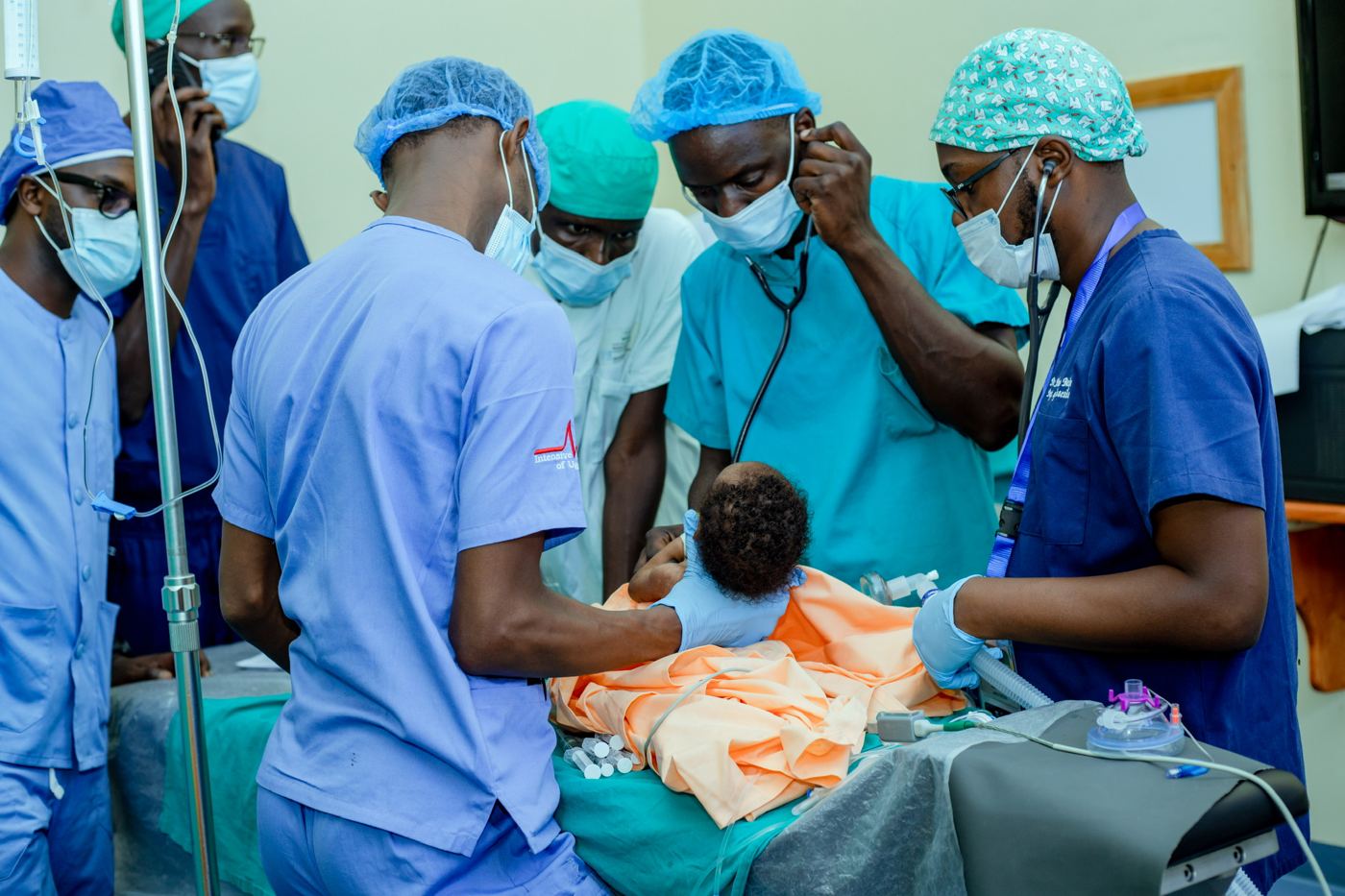
Quick answer: The Next 100 surgical camps in Uganda treat nine conditions: gastroschisis, omphalocele, anorectal malformation, Hirschsprung’s disease, abdominal wall hernias, undescended testis, cleft palate, soft tissue masses and other excisions. Each can be treated with surgery, and for several of them waiting can be dangerous or fatal.
Part 2 of 3 · By Amigos Internacionales · Published October 28, 2026 · Updated November 6, 2026
In Part 1 we looked at how many children in Uganda wait for surgery. This guide explains the conditions we expect to see in The Next 100 surgical camps and what each operation does. Uganda’s Ministry of Health and Amigos choose the cases together, and the children in the greatest danger come first.
On this page
- The nine conditions at a glance
- Newborn emergencies
- Common childhood conditions
- Conditions that change a child’s life
- Words you may hear
- Frequently asked questions
The nine conditions at a glance
| Condition | What it is | Usual treatment | Why timing matters |
|---|---|---|---|
| Gastroschisis | Intestines outside the body through an opening beside the navel, with no covering | Surgery returns the intestines to the abdomen and closes the wall, sometimes in stages | Newborn emergency. No baby with gastroschisis survived in the 2012 Kampala series |
| Omphalocele | Organs bulge out at the base of the umbilical cord inside a thin sac | Surgery returns the organs and closes the wall, sometimes in stages | Newborn emergency. Other conditions may need care too |
| Anorectal malformation | No normal opening for passing stool | Surgery. Some babies first have a temporary colostomy | Most children in a Mbarara study arrived late |
| Hirschsprung’s disease | Nerve cells missing from part of the bowel, blocking stool | Operation removes the affected section and connects healthy bowel. Some babies first have a colostomy | Late arrival and young age were the main risk factors for death in a Tanzanian study |
| Abdominal wall hernia | Tissue pushes through a weak spot, often in the groin or at the navel | Surgery closes the weak spot | A stuck (incarcerated) hernia is an emergency |
| Undescended testis | One or both testes have not moved into the scrotum | A short operation moves the testis into place | Easiest to treat in early childhood; leaving it can affect fertility later |
| Cleft palate | An opening in the roof of the mouth | Surgery closes the palate | Affects feeding, ears and speech |
| Soft tissue masses | Lumps in or under the skin or in other soft tissue | A surgeon examines the lump; some are removed | Depends on the lump |
| Other excisions | Other growths or tissue causing pain, infection or disfigurement | Surgical removal | Depends on the case |
Newborn emergencies

What is gastroschisis?
A baby is born with an opening in the abdominal wall beside the navel, and the intestines are outside the body. Surgery places the intestines back inside and closes the abdomen, sometimes in stages. Newborns need careful warmth, fluids and breathing support before and after the operation. In the Kampala newborn study described in Part 1, no baby with gastroschisis survived. Study summary.
What is an omphalocele?
Some of a baby’s organs, such as the intestines, bulge out at the base of the umbilical cord and are covered by a thin sac. Surgery returns the organs to the abdomen and closes the wall, again sometimes in stages. Babies with an omphalocele can have other conditions that also need care.
What is an anorectal malformation?
A baby is born without a normal opening for passing stool. Treatment is surgical. Some babies first have a temporary colostomy, and later an operation builds the opening in its proper place. At Mbarara Regional Referral Hospital, researchers found that most children with this condition arrived late. Study record.
What is Hirschsprung’s disease?
Nerve cells are missing from part of the bowel, which blocks the passage of stool. The operation removes the affected section and connects healthy bowel to the exit, and some children first need a temporary colostomy. A study in northwestern Tanzania found that late arrival and very young age were the main risk factors for death. Read the study.
Common childhood conditions
What is an abdominal wall hernia?
Tissue pushes through a weak spot in the abdominal wall, often in the groin or at the navel. Surgery closes the weak spot. A hernia that becomes stuck (incarcerated) can cut off the blood supply to the bowel, which is an emergency. A review of 22 studies found that about 7 percent of children waiting for a planned repair developed incarceration. Review summary.
What is an undescended testis?
One or both testes have not moved down into the scrotum. A short operation moves the testis into its proper place. It is easiest to treat in early childhood, and leaving it can affect fertility later.
Conditions that change a child’s life
What is a cleft palate?
There is an opening in the roof of the mouth. It can make feeding difficult and can lead to ear infections and speech problems. Surgery closes the palate. Amigos also repairs clefts through the Bethel Smile program.


What are soft tissue masses?
These are lumps in or under the skin or in other soft tissue. A surgeon examines the lump, and some are removed to relieve pain or disfigurement or to find out what they are.
What are other excisions?
“Excision” means cutting out. This covers the surgical removal of other growths or tissue that cause a child pain, infection or disfigurement.
Words you may hear
| Word | What it means |
|---|---|
| Congenital | Present from birth |
| Newborn (neonate) | A baby in the first weeks of life |
| Colostomy | A temporary opening in the belly wall that lets stool leave the body while the bowel heals or waits for a later operation |
| Incarcerated hernia | A hernia that has become stuck and cannot be pushed back |
| Strangulation | When a stuck hernia cuts off the blood supply to the bowel |
| Excision | Surgical removal of a growth or tissue |
Frequently asked questions
What is the difference between gastroschisis and omphalocele?
In gastroschisis, the intestines come out through an opening beside the navel, with no covering. In an omphalocele, organs bulge out at the base of the umbilical cord inside a thin sac. Both need surgery.
What is the survival rate for gastroschisis in Uganda?
Outcomes depend heavily on how quickly a baby reaches a surgical team and intensive newborn care. In a 2012 study at Uganda’s national referral hospital, no baby with gastroschisis survived, which is why timely surgery matters so much.
What is an anorectal malformation and how is it treated?
A baby is born without a normal opening for passing stool. Treatment is surgery, and some babies first have a temporary colostomy before a later operation builds the opening in its proper place.
What is the treatment for Hirschsprung’s disease?
Treatment is surgery. The operation removes the affected section of bowel and connects healthy bowel to the exit, and some children first need a temporary colostomy.
What happens when a child’s hernia gets stuck?
A stuck (incarcerated) hernia can cut off the blood supply to the bowel, which is an emergency that needs prompt surgical care.
When should an undescended testis be treated?
It is easiest to treat in early childhood, with a short operation that moves the testis into the scrotum. Leaving it can affect fertility later.
What does cleft palate surgery do?
A cleft palate is an opening in the roof of the mouth that can make feeding difficult and lead to ear infections and speech problems. Surgery closes the palate.
Which conditions does The Next 100 treat?
Nine: gastroschisis, omphalocele, anorectal malformation, Hirschsprung’s disease, abdominal wall hernias, undescended testis, cleft palate, soft tissue masses and other excisions.
How are children chosen for a Next 100 camp?
Uganda’s Ministry of Health and Amigos Internacionales choose the cases together. The children in the greatest danger are accepted first.
What does one surgery cost?
Each surgery is $200. A gift of $100 a month pays for six surgeries a year. See how to take a seat.
Are the children’s records kept private?
Yes. Our health records system identifies each child by a case number, not a name.
Why does this matter?
Many of these children would otherwise live with pain and disfigurement, and for some of them the condition can be fatal. Each seat in The Next 100 pays for six of these operations every year at $200 a surgery. Take a seat, then read Part 3 to see what happens inside a camp.
Read what happened: 120 children had free surgery at the first Next 100 camp in Arua, and every ICU case is home.
This guide explains conditions in general terms and is not medical advice for any individual child. A doctor should assess any child with one of these conditions.
Leave a Reply