

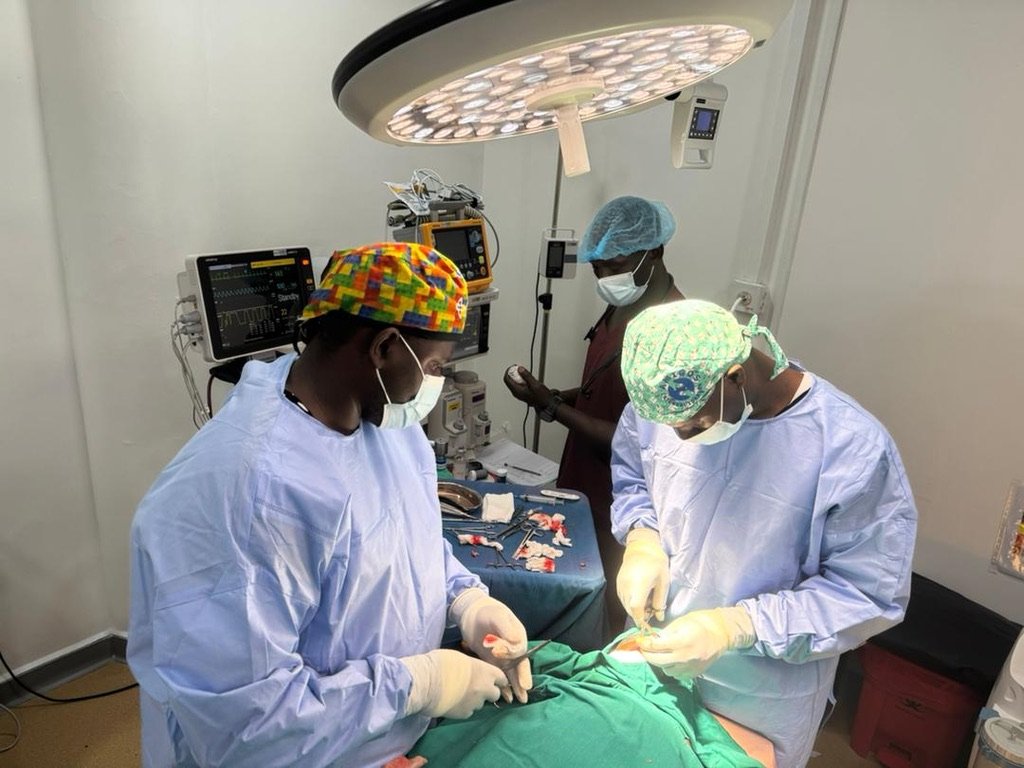
Quick answer: In Uganda, many children with treatable surgical conditions never reach a surgeon in time. A nationwide survey found that 7.4 percent of children had an untreated surgical condition, and at the national referral hospital 55 percent of newborns with surgical conditions who did not get an operation died. The Next 100, a program of Amigos Internacionales working with Uganda’s Ministry of Health and Doctors on Mission International, plans surgical camps for up to 600 children a year.
Part 1 of 3 · By Amigos Internacionales · Published October 28, 2026 · Updated November 6, 2026
For a child born in rural Uganda with a condition a surgeon could fix, the greatest danger is often time. The nearest surgeon may be a day’s travel away, and the family may not have the fare. For a newborn, the window to help can be measured in days.
On this page
- Key facts
- How many children need surgery?
- Why newborns have the least time
- How many pediatric surgeons does Uganda have?
- Why children arrive late
- The studies at a glance
- What The Next 100 is doing about it
- Frequently asked questions

Key facts
- 7.4 percent of Ugandan children surveyed had a surgical condition that had never been treated (2,176 children).
- 31.1 percent of child deaths in the surveyed households (28 of 90) were linked to a cause surgery could treat.
- 55 percent of newborns with surgical conditions who did not get an operation died at Uganda’s national referral hospital in 2012. Among those operated on, 88 percent survived.
- About 3.5 percent of the need for newborn surgery was being met, according to the same study.
- Nine fellowship-trained pediatric surgeons serve about 20 million children, and eight of the nine work in Kampala (2024 review).
- The Next 100: a camp every two months for up to 100 children, up to 600 children a year and up to 1,800 over three years.
How many children in Uganda need surgery?
A nationwide household survey of 2,176 Ugandan children found that 14 percent had a surgical condition at some point in their lives, and 7.4 percent had one that had never been treated. Researchers also asked about children who had died in those households. Of 90 child deaths, 31.1 percent were linked to a cause that surgery could treat. Read the survey.
Why do newborns have the least time?
At Uganda’s national referral hospital in Kampala, researchers reviewed children’s surgery admissions and consultations during 2012. Of 724 patients, 167 were newborns. Among newborns who had an operation, 88 percent survived. Among those who did not get surgery, 55 percent died. The researchers estimated that only about 3.5 percent of the need for newborn surgery was being met. Read the study summary.
Babies born with gastroschisis, where the intestines sit outside the abdomen, had the worst outcome in that study: none survived. This was one hospital in one year, so the numbers are a snapshot and not a national rate. They show how much depends on reaching a surgical team quickly.
How many pediatric surgeons does Uganda have?
A 2024 review in Discover Health Systems counted nine fellowship-trained pediatric surgeons in Uganda for a pediatric population of about 20 million. Eight of the nine work in Kampala. The review also found that children in the rural north travel farther to reach surgery than children in the central and eastern regions.
Why do children arrive late for surgery?
Distance, the cost of travel and limited surgical capacity all play a part. Late arrival is the common thread in the research on these conditions:
- Anorectal malformations. At Mbarara Regional Referral Hospital in southwest Uganda, about 63 percent of the 78 children studied arrived more than 48 hours after birth. Overall mortality was about 9 percent.
- Hirschsprung’s disease. In a five-year study of 110 children at a hospital in northwestern Tanzania, most arrived late with complications. Mortality was 21.8 percent, and very young age and delayed arrival were the strongest predictors.
- Hernias. At a children’s hospital in Addis Ababa, the average wait for surgery was about five months. About one in four children arrived with an incarcerated (stuck) hernia, and 3.8 percent had strangulation. A review of 22 studies found that about 7 percent of children waiting for a planned repair developed incarceration.
None of these studies can count the children who never reach a hospital. The Kampala researchers describe that gap as a hidden burden of mortality: children who die without being counted.
The studies at a glance
| Finding | Where | Source |
|---|---|---|
| 7.4% of children had an untreated surgical condition | Uganda, nationwide household survey of 2,176 children | Survey |
| 55% of newborns without surgery died; 88% of those operated on survived | Uganda’s national referral hospital, 2012 | Study summary |
| 63% of children with anorectal malformations arrived late; about 9% died | Mbarara Regional Referral Hospital, Uganda | Study record |
| 21.8% mortality for Hirschsprung’s disease | Northwestern Tanzania, 110 children over five years | Study |
| About one in four children arrived with a stuck hernia after an average five-month wait | Addis Ababa, Ethiopia | Study summary |
| About 7% of children waiting for a planned hernia repair developed incarceration | Review of 22 studies | Review summary |
What is The Next 100 doing about it?
Under a three-year memorandum of understanding signed on September 14, 2026 by Uganda’s Ministry of Health, Doctors on Mission International and Amigos Internacionales, a surgical camp opens about every two months at a hospital in the program, for up to 100 children. The Ministry provides operating theatres, children’s wards and nursing. Amigos and Doctors on Mission provide the surgeons, anesthetists, medicines, supplies and equipment, and Amigos pays the cost of supplies, visiting personnel and logistics for all camps, funded by donor gifts. The Ministry and Amigos choose the cases together, and the children in the greatest danger come first. Surgery is free for families.

Keep reading: Part 2, a plain-language guide to the nine conditions and Part 3, inside a surgical camp. See also the press release, our medical work, the Amigos Health Management System where results are recorded, and the places we serve.
Frequently asked questions
How many children in Uganda need surgery?
A nationwide household survey of 2,176 Ugandan children found that 14 percent had a surgical condition at some point in their lives and 7.4 percent had one that had never been treated.
What percentage of newborns in Uganda die without surgery?
In a 2012 study at Uganda’s national referral hospital, 55 percent of newborns with surgical conditions who did not get an operation died, while 88 percent of those who were operated on survived. It was one hospital, so treat it as a snapshot and not a national rate.
Why do children in Uganda arrive late for surgery?
The nearest surgeon may be a day’s travel away, families may not have the fare, and surgical capacity is limited. Studies of several conditions found that most children arrive late.
How many pediatric surgeons does Uganda have?
A 2024 review in Discover Health Systems counted nine fellowship-trained pediatric surgeons for about 20 million children, and eight of the nine work in Kampala.
What is The Next 100?
The Next 100 is a program of Amigos Internacionales. Under a three-year memorandum of understanding signed on September 14, 2026 with Uganda’s Ministry of Health and Doctors on Mission International, a children’s surgical camp opens about every two months for up to 100 children.
How many children will The Next 100 operate on?
Each camp is planned for up to 100 children, which is up to 600 a year and up to 1,800 over the three-year agreement. The exact number can vary from camp to camp.
Is surgery free for families in The Next 100?
Yes. Under the agreement, services are free to patients unless the partners agree otherwise.
How can I help children in Uganda get surgery?
A gift of $200 pays for one child’s surgery, and $100 a month pays for six surgeries a year. Take a seat on The Next 100. Amigos Internacionales is a 501(c)(3) nonprofit based in Whitehouse, Texas, and gifts are tax-deductible as allowed by law.
This article explains research and programs in general terms. It is not medical advice for any individual child.
Leave a Reply