

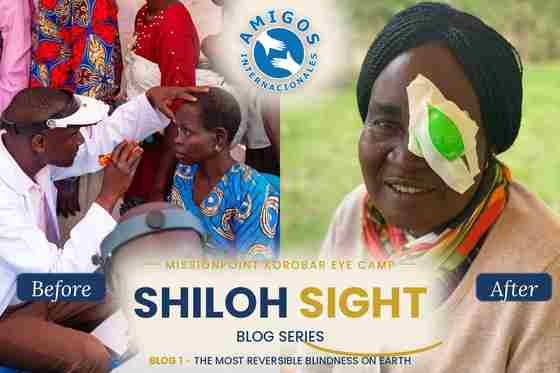
Cataracts blind more people than any other condition on earth, and the surgery that reverses them takes less than an hour. This October 9–11, Shiloh Sight is bringing that surgery, free, to Anaka General Hospital in Nwoya District, Uganda, for more than 100 people who have had no way to reach it.
I want to start this series with a fact that still stops me.
Of all the reasons a human being goes blind, the single biggest one is also the most fixable. In 2020, researchers estimated that about 17 million people worldwide were blind because of cataracts, roughly four out of every ten cases of blindness on the planet. Not disease that has no cure. Not injury that can’t be undone. A clouded lens that a trained surgeon can remove and replace in less time than it takes to eat lunch.
In most of the world, that is a routine outpatient procedure. You go in one morning, you go home that afternoon, and in a few days you are reading again.
In Nwoya District, in northern Uganda, people are still going blind from it. Slowly. One eye, then the other. A grandmother stops recognizing faces. A farmer stops being able to work his own field. A child leads a parent by the hand to church.

The problem is not the surgery. It is the distance.
Nwoya is farm country. It is the district we have been writing about for months, the place that spent two decades in displacement camps during the LRA war and is still rebuilding. Specialized eye care is not something that comes to a place like that on its own. An ophthalmologist, the equipment for cataract surgery, the lenses, the follow-up care: all of it lives in the cities. If you are blind and poor and live in a village outside Anaka, the surgery that could give you your sight back might as well be on the moon.
I have watched this play out at our eye camps before. Dennis walked fifty kilometers, blind, to reach one of them, because someone told him there were doctors who could help him see. We have his story on film, and I’ll share it with you, along with another man’s testimony that I still can’t tell without stopping, in Part 3.
What I want you to understand now is simpler. The surgery works. It has worked at every Shiloh Sight camp we have run, more than 270 cataract surgeries across just five camp days in our recent outreaches. The medicine is not the hard part. Getting the medicine to the people is.

What is happening at Anaka in October
On September 15, Dr. Paul Mulyamboga, our field physician in Uganda and the doctor who leads our medical camps there, sent me a voice note. Here is what he is planning, in his words:
“This presents to us a very wonderful opportunity to be able to offer free eye checkups, free eye treatment, free eyeglasses, and most importantly, an opportunity for us to be able to offer cataract surgeries for those that come with cataracts. We shall be in position to provide eyesight to those who have cataracts, and after the surgeries, they’re able to go back home smiling.”
Dr. Paul Mulyamboga, September 15, 2026
The camp runs October 9–11 at Anaka General Hospital, a district hospital not far from Gulu and close to our Korobar MissionPoint, where we held a community medical camp just last month. Amigos is partnering with Charity Vision International’s Uganda office and with Global Eyeglass Ministry from the United States. Together the team expects to serve more than 100 people with eye examinations, treatment, glasses, and, for those who need it, cataract surgery. Every service is free to the patient.

Dr. Paul also asked our pastors to come. This is an evangelistic camp. People who arrive in the dark, in more ways than one, are going to hear about the Light of the World while they wait. We keep the medical results and the spiritual results in separate columns, and I’ll report both to you honestly when it’s over. But I won’t pretend they are unrelated. Shiloh Sight was named for a reason, and I’ll tell you that story in Part 2.
What it takes
The goal for this camp is $5,000. That covers the full cost to Amigos of putting a surgical eye team in Anaka for three days and serving more than 100 people: the medicines, the lenses, the glasses, the logistics, the follow-up, and the administration that makes sure every patient is recorded and every dollar is accounted for.
Dr. Paul said something in that voice note that I want to pass along exactly as he said it, because it is the truest description of what a gift to this camp actually buys: “You’ll be able to see someone receiving eyesight because of your generosity.”
Not metaphorically. Literally. We will be there with cameras, and I will show you.
If you can’t give, pray. Pray for the patients who are deciding right now whether the walk is worth it. Pray for Dr. Paul and the surgical team. Pray for the pastors who will sit with people in the waiting line. And share this with someone who needs to know that the most reversible blindness on earth is, in fact, reversible, even in Nwoya.
This is Part 1 of a six-part series on Shiloh Sight, the Amigos Internacionales cataract and eye-care program, and the October 2026 eye camp at Anaka General Hospital near our Korobar MissionPoint. The photos above are from recent Amigos outreach near Korobar — Parts 3–6 of this series will carry real photos and video from inside the Anaka eye camp itself, October 9–11. Next: Part 2, Why We Call It Shiloh. Global cataract figures are from a 2024 meta-analysis of 2000–2020 data published in the journal Eye.
Leave a Reply