

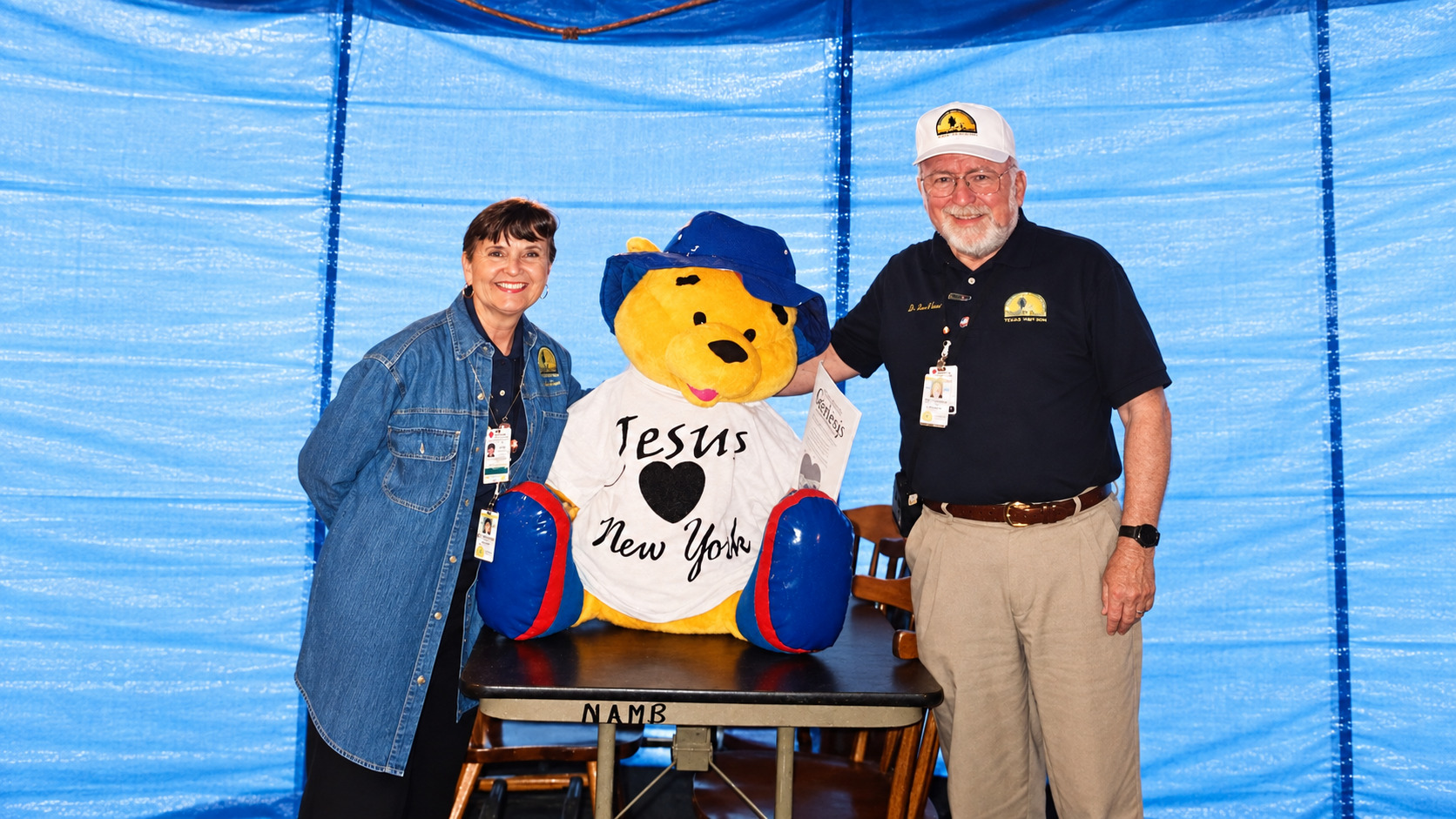
After the World Trade Center towers fell on September 11, 2001, Americans faced a question no one had prepared to answer: What do we do now? Drs. John and Kaywin LaNoue answered it by going to New York, serving for more than three months, and accepting an assignment that sounded almost too small for such an enormous tragedy: take care of the teddy bears. Now 91 years old and still active in ministry, Dr. John can tell the story in his own words.
What did people do after the buildings came down?
Some searched. Some cooked. Some cleaned. Some listened. Some prayed. Across the country, people collected supplies and traveled toward a city in pain because doing something—however ordinary—was better than standing helplessly at a distance.
John and Kaywin were among them. In his memoir, Walking with God in Broken Places, Dr. John remembers watching the attacks unfold while still recovering from cancer surgery, radiation and treatment. He contacted Baptist disaster-relief leaders and soon traveled with Kaywin to Atlanta to help organize response teams. About a week later, they drove their motor home to New York for what became an extended deployment.
Their base was at the Brooklyn Naval Yard. Volunteers helped feed workers, supported the Salvation Army kitchen near Ground Zero and cared for approximately 150 Baptist volunteers arriving each week. Those volunteers entered ash-covered homes and cleaned more than 750 apartments without charge—work commercial firms were reportedly quoting at thousands of dollars per apartment.
This was the response after the headlines: people found the next necessary job and did it.
Why were there thousands of teddy bears?
Americans had begun sending teddy bears to New York as tangible messages of care. According to Dr. John’s account, more than 40,000 bears accumulated in area warehouses, with more still arriving. Disaster-relief leader Mickey Caison brought John a special request connected to Mayor Rudolph Giuliani’s office: organize the bears and get them to people who needed them.
John’s first reaction was honest. With workers feeding responders and cleaning buildings, teddy bears did not sound like the most important assignment. But he accepted it—and learned one of the enduring lessons of the experience: in a disaster, we do not always know which assignment will matter most.
John and Kaywin selected six volunteers, rented a Ryder truck and began sorting bears from warehouses in New York and New Jersey. Notes addressed to firefighters, police officers and victims’ families stayed with their bears. What looked like a pile of donated toys became thousands of individual messages: someone remembers you; someone cares; you are not alone.
Where did the bears go?
The team carried bears to fire stations, police stations and the Victim Family Service Center. Approximately 1,500 Care Bears with movable casts and bandages were placed in New York City ambulances for pediatric calls. One hundred “prayer bears” went to children in a hospital ward.
Police officers kept returning for more. Dr. John wrote that the NYPD used the bears when officers visited victims’ families, emptying and refilling a refrigerator-sized box day after day.
One encounter captured the strange tenderness of that season. At a military checkpoint, an Army lieutenant inspected the truck after hearing that it contained teddy bears. Once satisfied, he asked whether he might have one. He walked away with an M-16 under one arm and a teddy bear under the other.
Kaywin also remembered offering a bear to an exhausted firefighter. “You look like you need a bear,” she told him. His answer was simple: “I do. I really do.”
How can a teddy bear become disaster relief?
A teddy bear cannot rebuild a tower or erase a family’s loss. But it can give a frightened child something to hold. It can help a police officer begin an impossible visit. It can tell an exhausted firefighter that people far away have not forgotten him.
Most importantly for John and Kaywin, the bears opened doors. They created opportunities to listen, counsel and pray with people who might never have approached a minister or disaster-relief chaplain. Practical compassion earned the right to be present.
A police officer later told Kaywin that she would never know what the bears and donated shirts meant to the department’s morale—simply because they showed that somebody cared.

The lesson twenty-five years later
The most useful question on this anniversary may not be only, “Where were you when the towers fell?” It may be, “What did people do after they fell?”
They took the next shift. They served a meal. They washed ash from a stranger’s apartment. They carried a bear into an ambulance. They sat with people whose lives had changed in a morning.
At 91, Dr. John remains active and continues sharing the lessons learned through decades of disaster relief and humanitarian ministry.
John and Kaywin’s story does not make the tragedy smaller. It shows how people responded when the need was larger than any one person could solve. They did not wait for an assignment grand enough to match the moment. They accepted the work in front of them.
That same principle still guides Amigos Internacionales: meet practical needs, work through trusted local leadership and remain present long enough for help to become hope. You can explore more firsthand records in the Amigos history and hear Dr. John tell the story in the Friends Helping Friends podcast.
Frequently asked questions
How long did John and Kaywin serve in New York?
They served in New York for more than three months following the September 11 attacks.
How many teddy bears did their ministry distribute?
Contemporary and later ministry accounts document the distribution of more than 22,000 teddy bears through the coordinated effort.
Who received the teddy bears?
Bears went to children, victims’ families, firefighters, police officers, hospitals and emergency medical crews. Some were carried in ambulances for pediatric emergencies.
Where does this account come from?
The primary account appears in Chapter 18 of Dr. John LaNoue’s memoir, Walking with God in Broken Places. Additional details were preserved by disaster-relief reporting and in Dr. John’s Amigos podcast episode, “God at Work During 9-11.”
Invite Dr. John LaNoue to share this firsthand story with your church, newsroom or community.
Leave a Reply